Why Infrared?
Light from the earliest galaxies — formed just a few hundred million years after the Big Bang — has been travelling for over 13 billion years. As the universe expands, this light is redshifted: its wavelengths stretch from visible and ultraviolet into the infrared. To observe these ancient objects, a telescope must be sensitive to infrared light.
The relationship between redshift and the scale factor of the universe is:
At — corresponding to roughly 480 million years after the Big Bang — visible light (400–700 nm) is redshifted to 4–8 micrometres, squarely in JWST's primary sensitivity range.
The Observatory
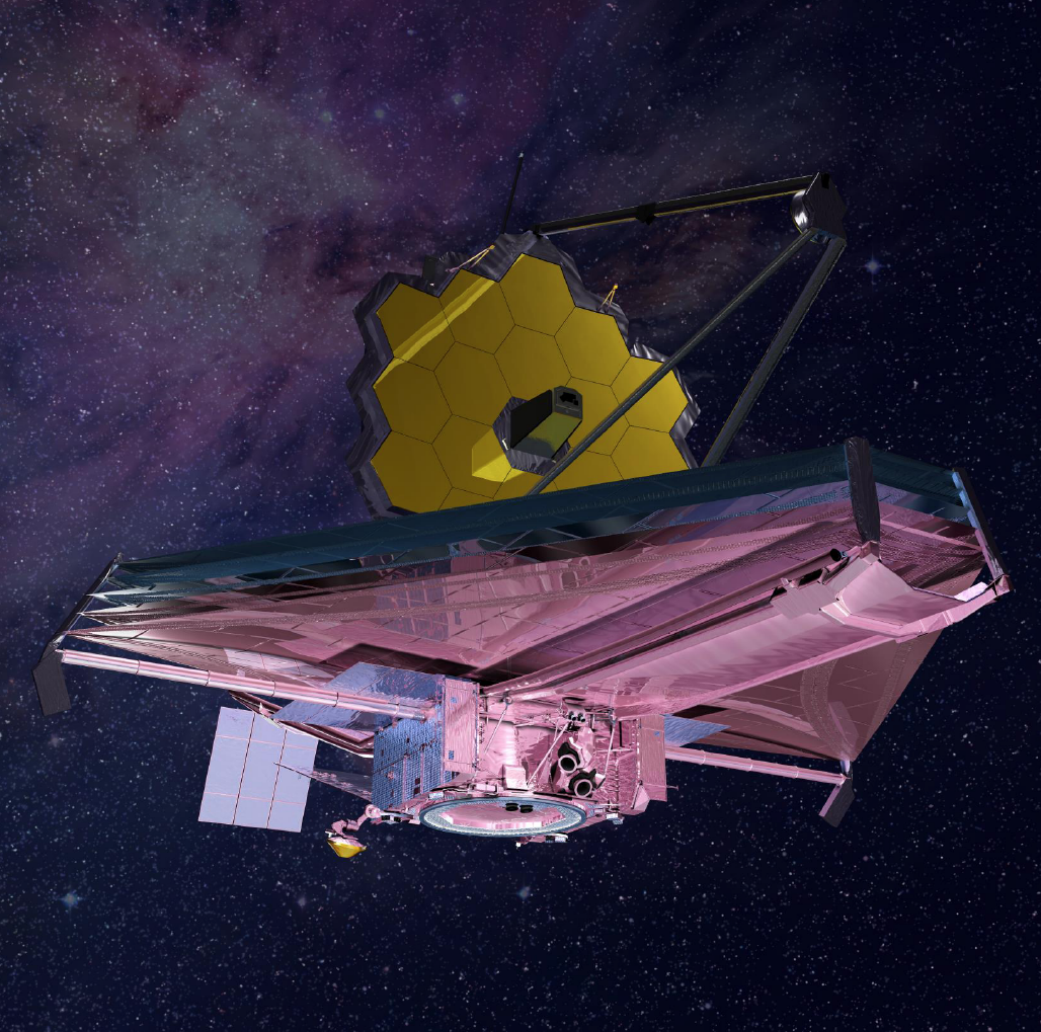
Primary Mirror: 6.5 metres in diameter, composed of 18 hexagonal beryllium segments coated in a thin layer of gold (optimised for infrared reflectivity). The mirror is too large to launch in one piece and unfolds in space — one of the most complex deployment sequences ever attempted.
Sunshield: A five-layer kite-shaped shield the size of a tennis court (21 × 14 metres) made from Kapton polyimide film. Each layer reflects and radiates heat; the combined effect drops the temperature from ~85°C on the Sun-facing side to ~−233°C (40 K) on the telescope side. JWST's detectors must be kept colder than deep space to avoid swamping their own infrared signal.
Instruments: NIRCam (primary imager, 0.6–5 µm), NIRSpec (multi-object spectrograph), MIRI (mid-infrared camera and spectrograph, 5–28 µm), and FGS/NIRISS (guidance and slitless spectroscopy).
L2 Lagrange Point
JWST orbits the Sun-Earth L2 Lagrange point — approximately 1.5 million kilometres from Earth in the anti-Sun direction. At L2, the gravitational forces of the Sun and Earth combine with centrifugal force to create a stable co-rotating position.
This is advantageous because the Sun, Earth, and Moon are always on the same side — the sunshield can permanently block all three heat sources simultaneously. Hubble, in low Earth orbit, experiences the Earth eclipsing the Sun every 90 minutes, causing thermal cycling that stressed its instruments.
Early Science Results
Within months of full operations in 2022, JWST delivered transformative results:
- Earliest galaxies: Candidate galaxies at , corresponding to less than 400 million years after the Big Bang — far earlier than Hubble could probe.
- Exoplanet atmospheres: Transmission spectroscopy of WASP-39b revealed carbon dioxide (), water, sulphur dioxide, and other molecules with unprecedented clarity.
- Stellar nurseries: The "Cosmic Cliffs" in the Carina Nebula revealed previously hidden protostars in extraordinary resolution.
- Solar system: Direct imaging of Neptune's rings and detailed storm tracking on Jupiter.
Looking Forward
JWST carries enough propellant for at least 20 years of operations — twice the minimum mission requirement — thanks to the precision of the Ariane 5 launch. Future observations will continue probing the epoch of reionisation, the atmospheres of potentially habitable exoplanets, and the formation of the first stars in the universe.