The Ultimate Physics Exam
Think about how an airplane lands on Earth. We have a thick atmosphere to provide lift and drag, a long paved runway, and human pilots making split-second decisions. Mars offers none of these luxuries. The Red Planet has a very thin atmosphere—only about 1% as dense as Earth's. It is just thick enough to burn up a spacecraft traveling at immense speeds, but far too thin to slow it down completely using parachutes alone.
If that wasn’t difficult enough, we have the issue of distance.
Why Rovers Must Land Themselves
As we know from how the Mars Relay Network operates, the distance between Earth and Mars means communication is not instantaneous. Depending on the orbits, a radio signal traveling at the speed of light can take anywhere from 3 to 22 minutes to travel between the two planets.
The entire process of entering the Martian atmosphere and touching the ground takes exactly seven minutes. This creates a terrifying reality for NASA engineers: by the time Earth receives the signal that the rover has hit the top of the Martian atmosphere, the rover has already been on the surface for several minutes—either perfectly safe or completely destroyed. The rover's onboard computer must execute the entire landing sequence completely autonomously.
Step 1: The Fire of Re-entry
When a spacecraft carrying a rover like Perseverance hits the Martian atmosphere, it is traveling at roughly 12,000 miles per hour (about 19,300 km/h). The friction between the atmosphere and the spacecraft generates intense heat, creating a glowing ball of superheated plasma. A massive heat shield protects the rover inside, with temperatures reaching up to 2,370°F (1,300°C).
Step 2: The Supersonic Parachute
Once the heat shield has done its job and the spacecraft has slowed down to about 1,000 mph, it deploys a massive parachute. Opening a parachute at supersonic speeds is incredibly violent, but it acts as a massive brake, pulling the spacecraft back. However, because the Martian air is so thin, the parachute alone isn't enough. The rover is still falling too fast.
Step 3: The Sky Crane Maneuver
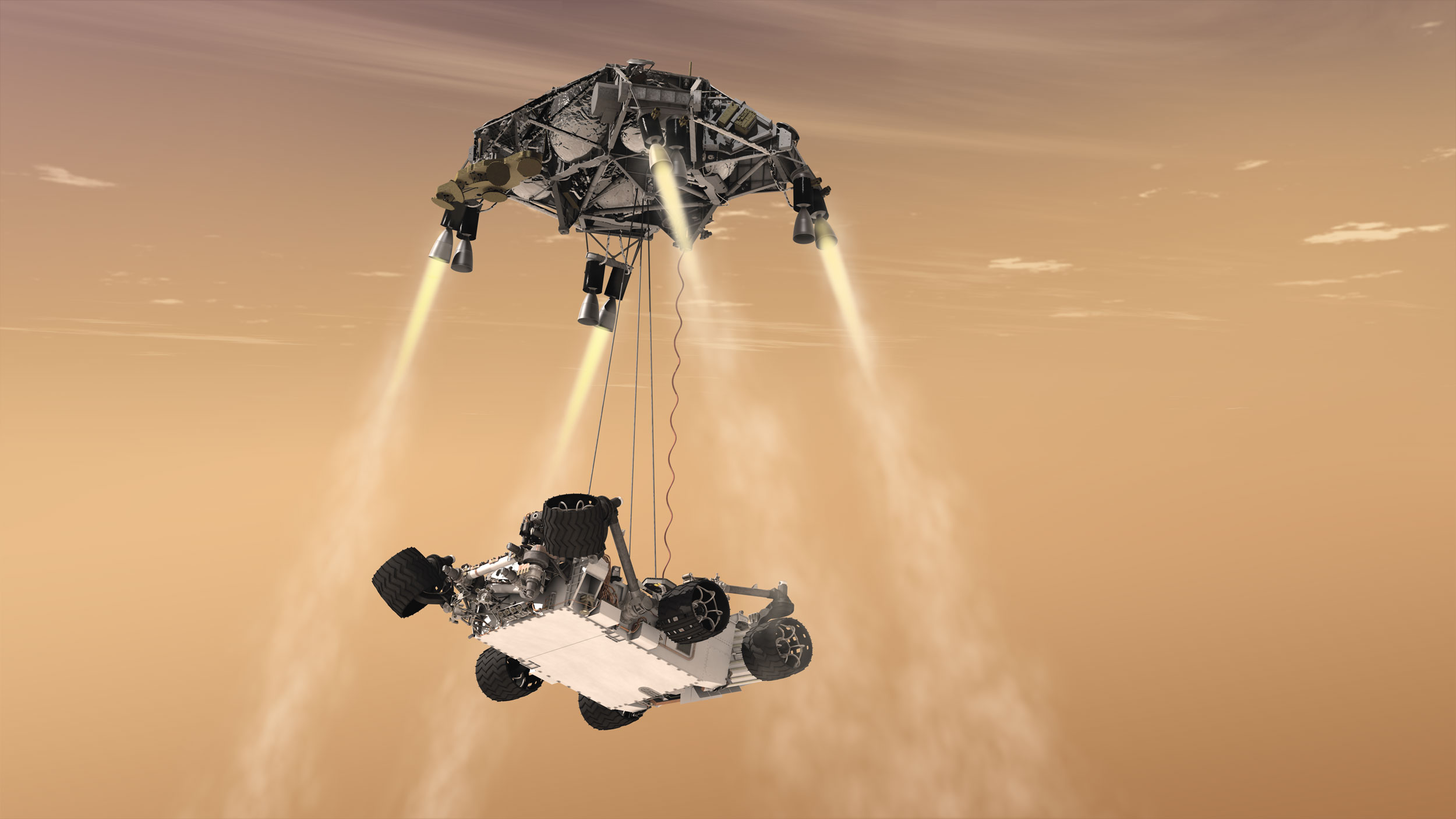
This is where the engineering looks like pure science fiction. About a mile above the surface, the rover drops out of the backshell and parachute. But it doesn't fall. It is attached to a "descent stage"—a jetpack powered by eight rocket engines.
These rockets fire toward the ground, slowing the descent to a walking pace of just 1.7 mph. To avoid kicking up a massive dust storm that could damage the rover's sensitive instruments, the jetpack halts about 65 feet in the air. It then uses strong nylon cables to gently lower the rover down to the surface.
Once the rover's wheels sense the solid ground of Mars, the cables are instantly cut. The jetpack then throttles up its engines and flies away to crash-land at a safe distance, leaving the rover ready to wake up, connect to the Mars Relay Network, and begin its mission