Beyond the Habitable Zone
When scientists look for life in the universe, they usually "follow the water." For a long time, that meant looking strictly inside the "Habitable Zone"—the specific distance from a star where it is warm enough for liquid water to pool on a planet's surface. Earth is right in the middle of this zone, while Mars sits just on the outer edge.
Jupiter, however, is way too far from the Sun. Its surface is freezing, and it doesn't even have solid ground. But its moons tell a very different story.
Hidden Alien Oceans
Thanks to previous missions like Galileo, we now know that several of Jupiter's massive moons—specifically Europa, Ganymede, and Callisto—are holding a massive secret. Beneath miles of solid, freezing ice, they harbor vast, global oceans of liquid saltwater. In fact, Jupiter's moon Europa alone might contain twice as much liquid water as all of Earth's oceans combined.
But how does the water stay liquid so far from the Sun? The secret is "tidal heating." Jupiter's immense gravity constantly pulls and squeezes these moons as they orbit, generating intense internal friction and heat. This heat keeps the subsurface oceans liquid and might even power deep-sea hydrothermal vents, much like the ones on Earth where life thrives in total darkness.
A Tale of Two Missions
To find out what is really going on beneath the ice, two massive flagship spacecraft are currently cruising through deep space on their way to the Jovian system:
ESA's JUICE (Jupiter Icy Moons Explorer): Launched by the European Space Agency, this probe is focused heavily on Ganymede, the largest moon in our solar system (it's even bigger than the planet Mercury!). JUICE will study Ganymede's hidden ocean and its unique magnetic field.
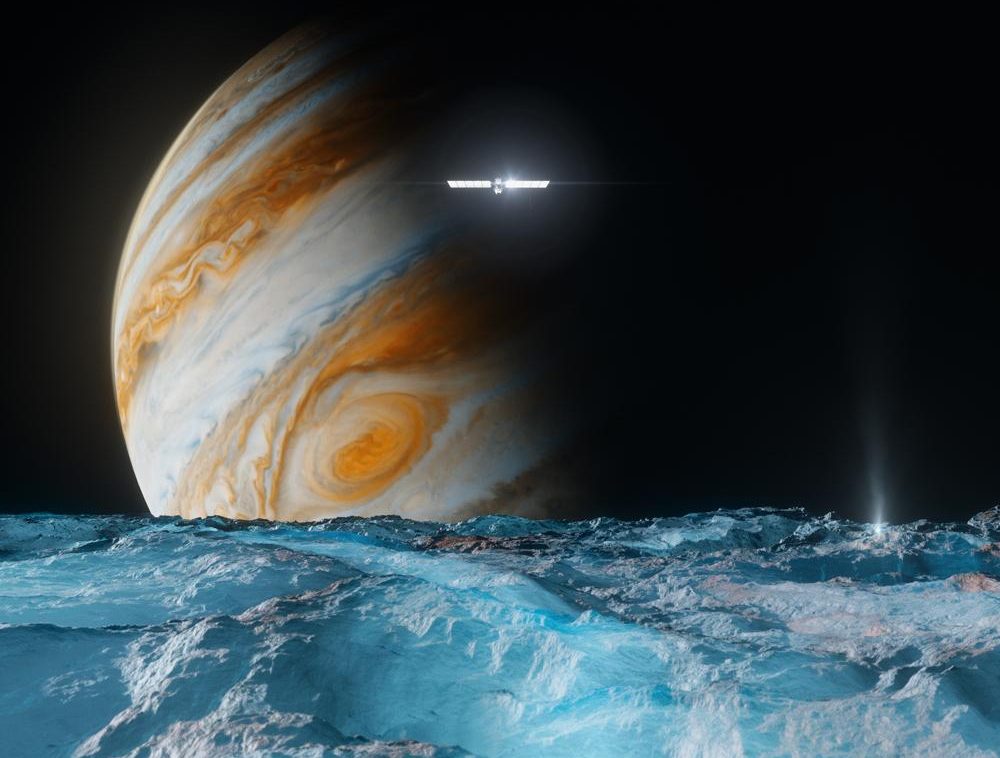
NASA's Europa Clipper: This heavily armored spacecraft is flying straight toward Europa. It is packed with ice-penetrating radar and spectrometers designed to scan the moon's frozen crust. Scientists are hoping the Clipper will fly directly through plumes of water vapor shooting out from cracks in the ice, allowing it to "taste" the ocean water without ever having to land.
The Search for the Ingredients of Life
Neither JUICE nor Europa Clipper are explicitly "life-finding" missions. They do not carry microscopes to look for alien fish. Instead, their goal is to determine if these moons are habitable. They are looking for the three critical ingredients for life as we know it: liquid water, essential chemical elements (like carbon, nitrogen, and oxygen), and an energy source.
If these spacecraft confirm that Jupiter's moons have all the right conditions, it will completely change how we view the solar system. It would mean that life doesn't just belong on warm, rocky planets near a star, but could exist in the dark, icy depths of deep space.